
News
Cashless gaming: where each state has landed, and what still isn’t settled
Cashless gaming is becoming an important topic in the country’s ongoing discussion about poker machine regulation, gambling harm minimization and financial transparency. Governments are exploring how digital payments, player accounts and identification systems could change the way people use electronic gaming machines (EGMs), commonly known as pokies.
However, no single approach applies across Australia. Each state and territory has its own gambling laws, regulatory priorities and implementation plans. Some jurisdictions are developing carded play requirements, while others are reviewing policy options or maintaining existing payment arrangements.
If you follow pokies news, visit gaming venues or want to understand responsible gambling safeguards, knowing where these reforms stand can help you make more informed decisions.
What Is Cashless Gaming in Australia?
Cashless gaming lets you load credits onto a gaming machine using a digital wallet, player card, or other approved electronic payment system instead of relying entirely on physical cash.
Depending on the system, you may also be able to review your transactions, monitor your spending and set personal limits. Some account-based systems require player identification and verification before you can play.
However, cashless gaming and mandatory carded play aren’t the same. A machine can support cashless payments without requiring every player to use an identified account. The distinction matters when governments consider gambling payment technology, anti-money laundering controls and responsible gambling safeguards.
Cashless Gaming by State and Territory
Australia’s cashless gaming policy remains developing. The following overview distinguishes documented reforms from proposals and unresolved implementation details.
New South Wales
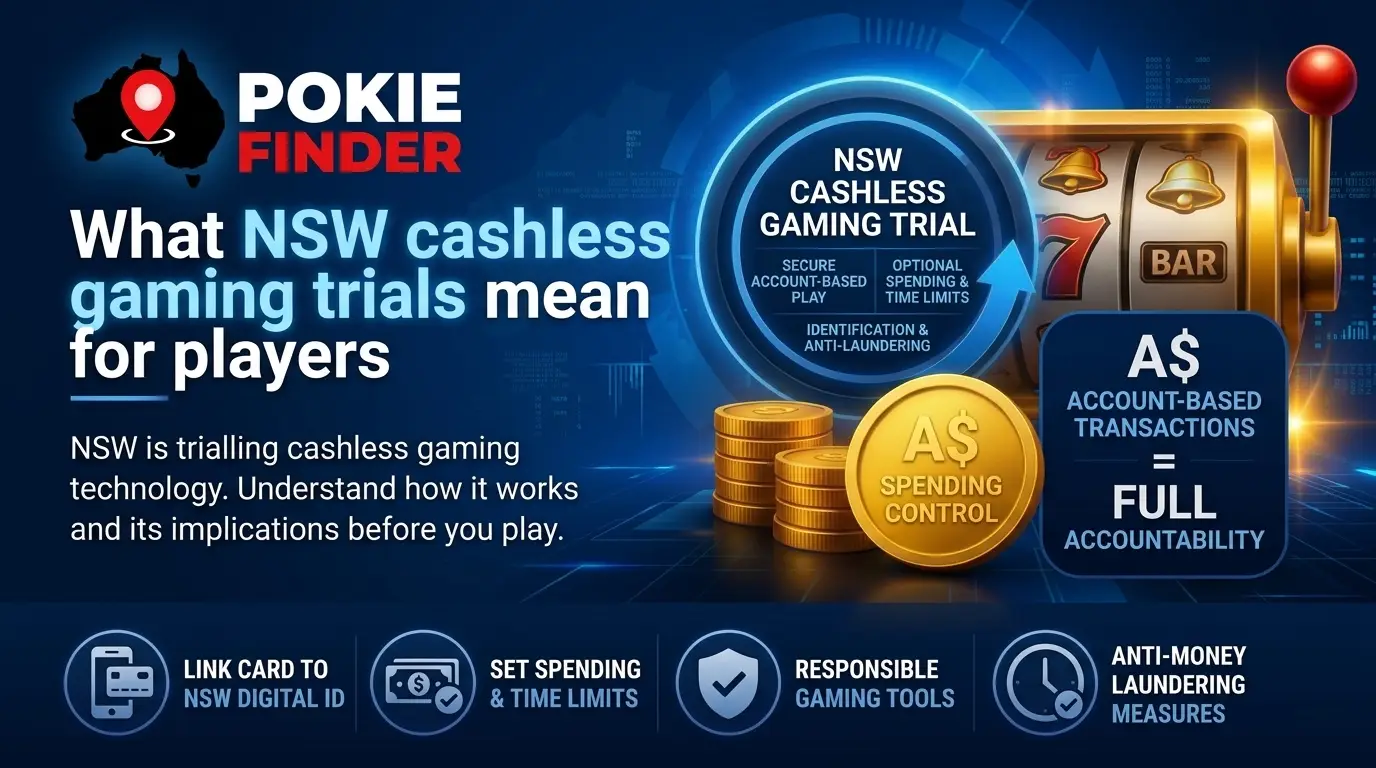
New South Wales (NSW) conducted a cashless gaming trial from March to September 2024, testing digital wallets at selected clubs and hotels. According to the NSW Government’s trial information, participation was voluntary.
The independent panel recommended a phased move towards statewide account-based gaming, with a proposed implementation pathway extending to 2028. However, the trial had limited participation: the ABC reported only 14 genuine and active participants in the relevant analysis. Researchers cautioned that the small sample was insufficient for statistically robust conclusions about the technology’s impact.
Read the ABC’s report on the NSW trial findings for the background.
The central question is how NSW could balance player identification, cash access, privacy, industry costs and meaningful harm minimization. The panel’s recommendation should not be confused with proof that a statewide mandate is already fully implemented.
Victoria
Victoria has legislated a framework for mandatory carded play and pre-commitment on electronic gaming machines. Carded play requires a player card to operate a machine, while pre-commitment lets players set spending or time limits.
However, implementation has required further planning. The Victorian regulator reported that the planned 2025 trial was postponed while the government considered implementation timeframes and technology options.
Check the Victorian Gambling and Casino Control Commission’s guidance for the latest confirmed position before relying on a particular start date.
The remaining questions concern rollout timing, system requirements and how mandatory safeguards will work across different venues.
Australian Capital Territory
The ACT announced a major gambling reform package on 15 September 2026. The proposed measures include mandatory account-based cashless gaming, stronger harm reduction controls, restrictions on ATM and EFTPOS cash withdrawals at venues with pokies, reduced operating hours and a long-term reduction in poker machine authorizations.
These are significant policy commitments, but an announcement alone does not establish that every measure is already operating.
You can follow developments through the ACT Government’s reform announcement.
Tasmania
Tasmania previously developed plans for a mandatory player card and pre-commitment system. However, progress was deferred in November 2024. In June 2025, the Tasmanian Liberal Party leader stated that the proposed card would not be introduced unless there was a national approach.
The unresolved issue is whether Tasmania will revisit the policy independently or wait for broader agreement across Australia. You can review the Tasmanian Treasury’s player card and cashless gaming information.
Queensland
Queensland has its own electronic gaming machine regulations and responsible gambling requirements. However, the sources reviewed for this article do not establish a confirmed statewide deadline for mandatory cashless gaming across all relevant venues.
Questions remain about whether future reforms will require identified player accounts, spending controls or wider cashless infrastructure. Proposed changes should be distinguished from enacted rules and operational requirements.
Western Australia
Western Australia’s gaming machine environment differs from other states because it restricts electronic gaming machines in the community, with permitted machines located at Crown Perth.
The state has announced plans for further harm minimization measures, including cashless gaming with carded play and weekly time or loss limits. The precise current implementation status of each measure should be checked against official updates.
See the Western Australian Government’s electronic gaming machine reform information.
South Australia
South Australia already permits technologies such as banknote acceptors and Ticket-In Ticket-Out (TITO) systems under specified rules. These arrangements demonstrate that electronic payment features can exist without automatically making every machine part of a mandatory identified account system.
The broader question is whether South Australia will introduce additional cashless gaming requirements beyond its existing technical and venue rules. Refer to Consumer and Business Services South Australia for current requirements.
Northern Territory
The Northern Territory regulates gaming machines through its own licensing and technical framework. Approved cashless systems may be possible, but that does not mean a universal statewide carded-play mandate has been established.
Any future changes will need to be assessed against the territory’s existing requirements, including gaming machine approvals, venue compliance and responsible gambling safeguards.
What Still Isn’t Settled?
Several important questions remain central to cashless gaming reform.
1. Will cashless gaming become mandatory everywhere?
No single implementation pathway is shared by every Australian jurisdiction. Governments must decide whether participation remains voluntary, becomes mandatory for particular venues, or expands to a wider account-based system.
2. How will privacy and financial data be protected?
Identified accounts can create detailed records of gambling activity. Clear rules are needed around data collection, access, storage, cybersecurity, and disclosure. Players also need to understand what information a system records and who can access it.
3. Will digital systems reduce gambling harm?
Cashless technology may support expenditure tracking, pre-commitment systems, and spending limits. However, effectiveness depends on system design, adoption, enforcement, and real-world evidence. Technology alone cannot guarantee that gambling-related harm will be prevented.
4. Who will pay for implementation?
Venues may need new hardware, software, staff training, and compliance processes. Governments and operators still need workable approaches to costs, technical standards and transition periods.
5. Will Australia adopt consistent national standards?
Different state rules can create uncertainty for operators, technology providers and players. A more consistent approach could simplify some requirements, but agreement on privacy, payment methods, safeguards and implementation timelines remains important.
Understand Pokies and Gaming Venues with PokieFinder
Cashless gaming in Australia is an evolving policy area, and the rules can differ depending on where you live and which venue you visit. Keeping up with official announcements helps you distinguish existing requirements from proposed changes.
For practical pokies information, PokieFinder helps you find nearby pokies venues and use its Pokies Validator to assess information about gaming-related websites. Check venue details before you visit, review available information carefully, and remember that finding a venue doesn’t mean its machines are cashless or that a particular system is available.
Looking for pokies near you in 2026? Visit PokieFinder to explore nearby venues and validate gaming-related information. Make informed choices, set personal limits, and seek support if gambling stops being enjoyable or affects your finances.